
Balance Power - Community Consultation
Balance Power Projects Ltd is proposing a Battery Energy Storage System (BESS) on land at Coylton Farm, south of Coylton substation.
Welcome
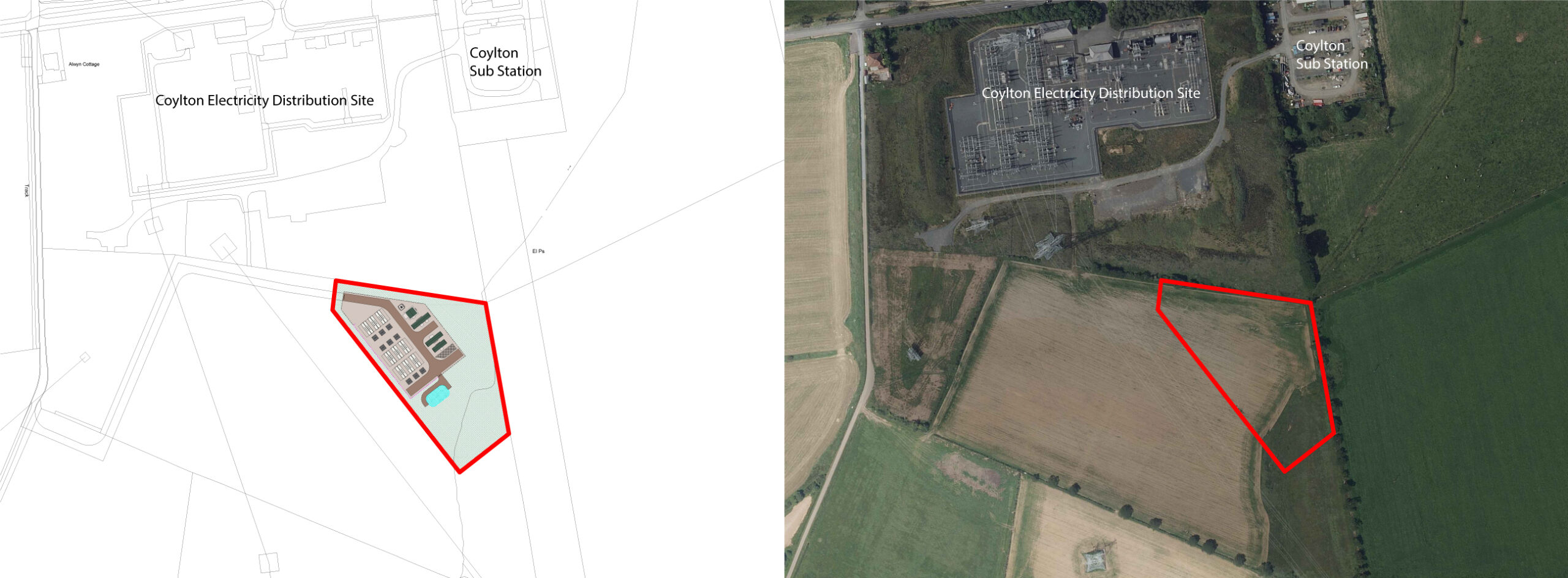
Balance Power is proposing to build and operate a battery energy storage system (BESS), on land directly to the south of the existing electricity substation at Coylton, south of the A70.
Located two km northeast of Drongan, and a similar distance to the east of Coalhall, the proposed application site redline boundary extends to 6.6 acres (2.67ha). The footprint of the built area housing the batteries, transformers and associated plant and machinery extends to 1.11 acres (0.45ha).
BESS are developments that store electricity, at times of high generation and low demand, via rechargeable batteries, and release this energy back onto the grid system in times of high demand. As heavily polluting but reliable and controllable coal and gas are removed from the grid and replaced by renewable sources (such as wind turbines), it is critical we maintain a resilient energy network.
With a capacity of around 29.9 megawatts (MW), this proposal is classified as a ‘major development’ under planning regulations. Before a planning application can be lodged, Balance Power must undertake two in-person public consultation events on the proposal.
Public Consultation
Balance Power originally commenced pre-application consultation on this proposal in June 2023.
Following a public consultation event and some further technical work, minor amendments to the site access from the A70 were deemed necessary. This has resulted in changes to the red line site boundary and recommencement of the pre-application consultation exercise.
Balance Power submitted a new proposal of application notice (PoAN, 23/0012/PREAPP) to East Ayrshire Council on 24 July, which formally notifies it of its intent to submit a planning application.
The planning application will be submitted after a minimum period of 12 weeks consultation, including two public consultation events. The purpose of these events is to give Balance Power the opportunity to present its proposals to the local community, and for the community to ask questions and to provide feedback.
A second public consultation event will take place on Tuesday 3 October at Drongan Primary School/Community Centre and Library, 18 Coronation Road, Drongan between 4pm and 7.30pm.
This follows the holding of a first event on Thursday 7 September at Ochiltree Community Hub.
In the lead-up to these events, leaflets will be circulated to all residential properties within 1km of the site. Leaflets will also be placed at various locations in the local community, with the event advertised in the local press.
Location
The image below contains a view of the proposed location.
Proposals
FAQs
Frequently Asked Questions (FAQs)
1. What is being proposed by Balance Power?
Leading energy project developer, Balance Power, is proposing to deliver a new battery energy storage system (BESS) development, neighbouring the Coylton electricity substation, located on the A70 between Coalhall and Ochiltree.
2. Who are Balance Power?
Balance Power is a leading energy project developer in the UK, having secured planning consent on more than 400MW of generating capacity, with a further 2.5GW of generating capacity under development.
It has delivered 35 energy projects and is continuing to develop a portfolio of solar and battery storage assets at strategic locations across the UK.
Balance Power is looking to bring forward the net-zero objectives recognised by the Scottish Government by accelerating the transition to a fully renewable energy mix, through deployment of suitable localised energy generation technologies.
Further information about Balance Power is available at: www.balancepower.co.uk
3. What is Battery Storage and why is it needed?
BESS are developments that store electricity, at times of high generation and low demand, and release this energy back into the grid system in times of high demand. As heavily polluting but reliable and controllable coal and gas, which contribute to climate change, are removed from the grid and replaced by renewable sources e.g. wind and solar, it is critical we maintain a resilient energy network.
Battery storage is vitally important to the grid system because it can provide power to homes and businesses when renewable energy supply is inconsistent i.e. the wind not blowing and the sun not shining, therefore stabilising the grid system, reducing blackouts and aiming at keeping electricity prices low.
The Scottish Government has set a target to be net-zero by 2045, with a 2030 target to generate 50% of Scotland’s overall energy consumption from renewable sources, and by 2050 to have decarbonised our energy system almost completely.
For these targets to be achieved, there must an increase in the number of wind and solar and farms. This means that more battery facilities are required to support the transition, allowing existing fossil-fuel facilities to be decommissioned over time and maintaining security of supply.
The development of renewable energy projects with BESS facilities also reduces our reliance on imported fuels, which serves to ensure a cheap and secure supply of energy to meet current and future demand.
4. What are the benefits of BESS?
Energy bills are at a very high level. The repercussions on homeowners and businesses are widely reported and the UK is facing a cost-of-living crisis. International events such as the war in Ukraine impact on energy security and fossil-fuel prices across the globe. There is an undisputed need to increase the amount of renewable energy to ensure a cheap and secure supply of energy to meet current and future demand.
Other benefits that battery storage facilities provide include the element of decarbonising and decentralising the power network. The more storage capacity that exists means fewer fossil-fuelled plants will be in operation which improves air quality, both locally and nationally, with consequential improvements in peoples’ health and quality of life.
Decentralising the power network means that by having battery storage operating in the network, less power is wasted because travel transmission distances are reduced, which in turn means that local communities and businesses can benefit from a reliable supply of energy.
Battery storage provides several environmental benefits. They are carbon zero in their operation and commonly include a rich landscaping scheme included as part of the development, which contributes towards a biodiversity net gain. Battery storage facilities also have a high energy to density ratio, meaning that for the amount of energy the batteries can generate, the amount of space which is taken is low.
This is especially relevant in comparison to say solar farms, which require a much greater amount of land take for an equivalent amount of power provided.
5. How can BESS projects bring down electricity bills?
In 2021 the National Grid costs to manage and mitigate issues caused by constraints caused by mismatches between renewable generation and demand profiles on the grid exceeded £1bn for the first time. These costs will continue to rise as more renewable generation is installed and if insufficient battery capacity is installed with it. BESS projects are key to bringing these costs down, which will benefit all energy consumers.
6. Can we be sure that BESS will also deliver a positive environmental impact as well?
Both the economic and environmental case for BESS hinges on the fact that the batteries will often import excess electricity from the grid during periods of high generation or low demand, and export electricity during periods of high demand.
Often the batteries are charged using excess cheap, zero-carbon electricity, which would otherwise have been lost through generation curtailment (see point above). This is then discharged during periods of high demand when more expensive, dirtier forms of generation (e.g. coal) are operational, to help balance generation and demand.
Work by Balance Power indicates that for every 1MWh of BESS installed, it is the equivalent of taking 25 cars off the road. Details of this can be found at https://www.balancepower.co.uk/news-insights/battery-compatability-with-a-net-zero-grid
7. Will this create traffic congestion?
All BESS developments are supported by a Construction Transport Management Plan that addresses road noise, safety, and congestion and manages the number of vehicles accessing the site at different times of the day/week.
8. What do batteries look like?
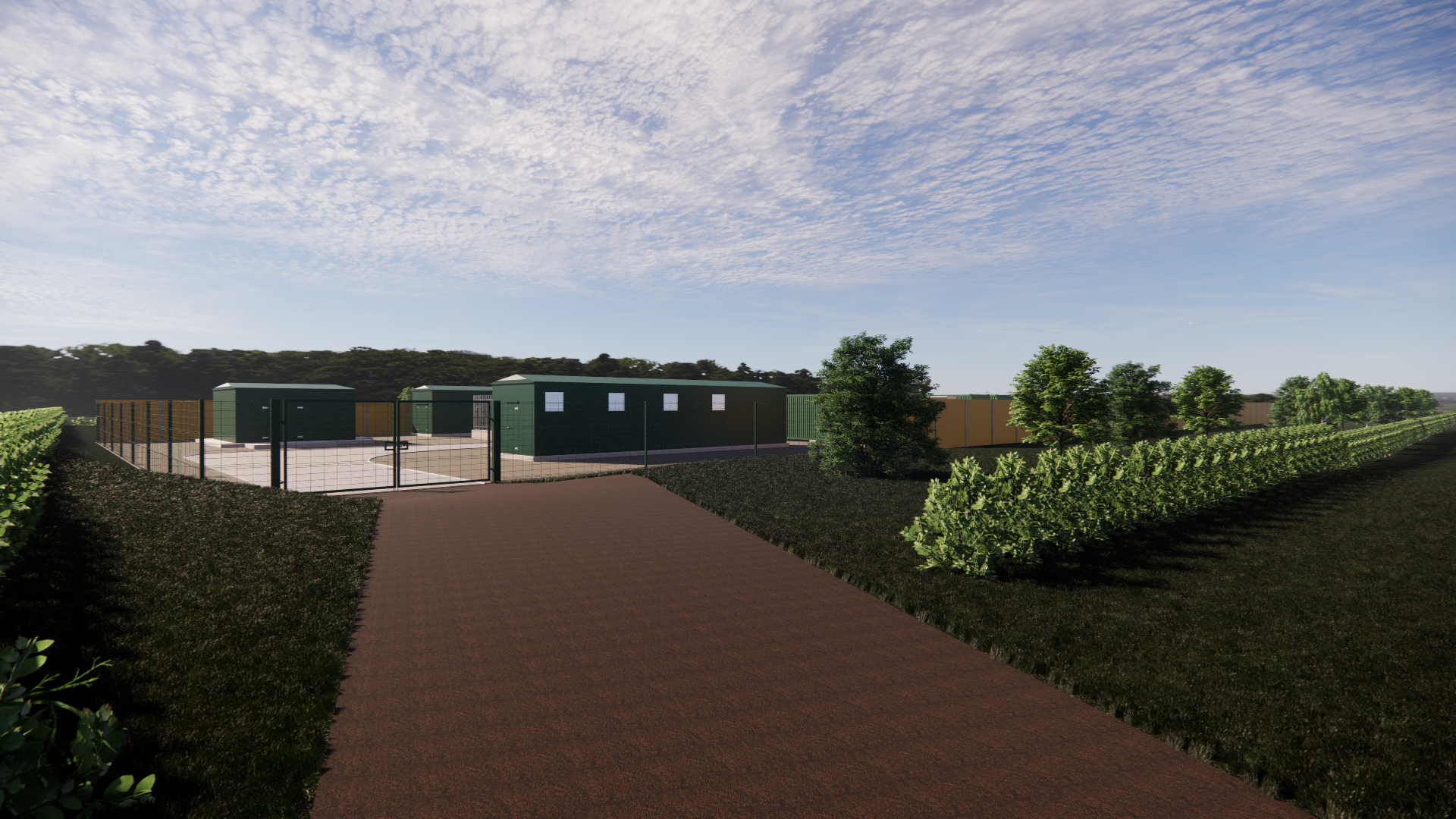
Battery storage facilities are similar in appearance to shipping containers. The design and siting of battery developments are tailored to minimise the visual impact by reducing height and locating them adjacent to existing infrastructure, in this case the Coylton electricity sub-station. By doing this the development can blend into the existing environment, whilst reducing adverse visual amenities.
9. Are batteries noisy?
There is a low level of noise emitted from batteries, however, we make sure that this level is no louder than the existing level of background noise.
10. How long will the battery be in operation and what will happen to the land afterwards?
The site will be decommissioned at the end of its life, potentially up to 40 years, with all equipment removed and the land returned to how it was before development started.
11. The area I live in is very dark at night, will batteries increase light pollution?
All battery sites include downward-facing motion sensor lighting that is only activated during emergencies, routine maintenance or for security reasons.
12. Do batteries cause increases in electromagnetic radiation?
Batteries do not cause electromagnetic radiation. There are elements of the proposed installation such as transformers and overhead cables that will produce some electromagnetic radiation. They are designed in accordance with stringent directives and codes which ensure that any electromagnetic emissions are kept to safe levels.
13. Where and how do you source the materials used in battery storage?
The sourcing of lithium and cobalt has been the subject of concern regarding some environmental and social impacts of mining and shipping. Despite these materials being widely used in all smart phones, as well as increasingly, in electric vehicles, we recognise such concerns exist and that people want to ensure high standards of such sourcing.
It is important to note that Balance Power do not manufacture our own batteries for use in developments such as this. Instead, we procure our materials from reputable suppliers. These suppliers are internationally recognised as being leading supporters of many new organisations and groups established to ensure materials are sourced ethically and responsibly. Balance Power is absolutely committed to increased ethical sourcing of lithium and cobalt.
14. What will I be able to see once the site is completed?
Our proposals incorporate a substantial area for planting around the perimeter of the site. This helps to screen the equipment and creates new habitats.
15. Why are you not developing on brownfield land?
Battery storage facilities are required to be close to suitable grid connections, hence these proposals neighbouring the Coylton electricity sub-station. Once a grid connection point is obtained, brownfield sites are prioritised over greenfield land. However, where a suitable brownfield site is unavailable, we carry out an alternative site assessment to choose the next best site.
16. Are batteries safe?
There are many mitigation measures in place both in the form of legislation and the BESS design itself to mitigate against chemical leakage. Safe transportation ensures no damage to the batteries prior to use. The BESS will be constructed in accordance with the International Electrotechnical Commissions standards for Electrical Energy Storage Systems. The planning application will be supported by a detailed fire safety assessment report.
Feedback
Please return forms by Friday 20 October 2023, to Orbit Communications, 42 Charlotte Square, Edinburgh EH2 4HQ or by email to hello@coyltonbatterystorage.co.uk
You can download a paper feedback form here.
Feedback Submission Form (Click to Open)
About
Balance Power Projects Ltd is a leading energy project developer in the UK, having secured planning consent on more than 400MW of generating capacity, with a further 2.5GW of generating capacity under development.
The company has delivered 35 Energy Projects and is continuing to develop a portfolio of solar and battery storage assets at strategic locations across the UK. Balance Power is looking to bring forward the net-zero objectives recognised by the Scottish Government, by accelerating the transition to a fully renewable energy mix, through deployment of suitable localised energy generation technologies.
For further information on Balance Power, please go to www.balancepower.co.uk
Contact
Thank you for your cooperation and for using this website.
For further information, or if you are not able to access the exhibition boards on the day of the event, please contact Orbit Communications on 0131 202 3259 or by email to hello@coyltonbatterystorage.co.uk